The China Helper
Your practical guide to studying, living and learning in China.
The China Helper
Your practical guide to studying, living and learning in China.


Learn Mandarin Pronunciation Step by Step with Pinyin, Initials, Finals, and Tones
Learning Chinese pinyin — the romanisation system behind Mandarin pronunciation — is the first and most important step for beginners. Unlike English, Chinese characters do not directly show pronunciation. For example:
How to use this guide
This is a practical learning guide, not the official standard. The Hanyu Pinyin scheme was approved by the National People’s Congress on 11 February 1958 and is also ISO 7098. Timing estimates here are rules of thumb reported by teachers, not official figures.
Last reviewed: September 2026 · Part of our Learn Chinese guide series.
The pronunciation system that connects Chinese characters with sounds is called Pinyin (拼音). Pinyin helps beginners:
This complete guide explains everything beginners need to know about Chinese Pinyin.
At a glance
Quick answer
Pinyin is three things: an initial, a final and a tone — and the four tones matter most, because mā, má, mǎ and ma are four different words. Two rules trip up nearly every beginner: the ü spelling rule and the special “i” sound after z, c, s, zh, ch, sh and r. A 30-day routine of tones → initials → finals → shadowing builds pronunciation people understand.
Chinese Pinyin is the official Romanization system used to represent Mandarin pronunciation. It uses:
Pinyin was adopted on 11 February 1958, when the National People’s Congress approved the Hanyu Pinyin Fang’an (Scheme for the Chinese Phonetic Alphabet) as the national standard for spelling Putonghua. It became an international standard in 1982 (ISO 7098), and Article 18 of the Law on the Standard Spoken and Written Chinese Language confirms it as the uniform norm for romanising Chinese personal names, place names and documents. Today it is widely used in:
For international students, Pinyin is usually the first step before learning thousands of Chinese characters.
Every Mandarin syllable usually consists of three parts:
Example:
Initial: n
Final: i
Tone: Third tone
Initial: h
Final: ao
Tone: Third tone
Together: n + i + third tone = nǐ
Initials are the consonant sounds at the beginning of a syllable. Mandarin has 23 commonly taught initials.
These sounds are similar to English.
| Pinyin | Example | Meaning |
|---|---|---|
| b | bā 八 | eight |
| p | pā 趴 | lie down |
| m | mā 妈 | mother |
| f | fā 发 | send |
| Pinyin | Example | Meaning |
|---|---|---|
| d | dà 大 | big |
| t | tā 他 | he |
| n | nǐ 你 | you |
| l | lǎo 老 | old |
| Pinyin | Example | Meaning |
|---|---|---|
| g | gāo 高 | high |
| k | kāi 开 | open |
| h | hǎo 好 | good |
These sounds are often difficult for beginners. Examples:
| Pinyin | Example | Meaning |
|---|---|---|
| j | jī 鸡 | chicken |
| q | qǐ 起 | rise |
| x | xǐ 喜 | like |
Important: j, q, x are pronounced with the tongue close to the front of the mouth. They are not the same as English “j”, “ch”, or “sh”.
These are called retroflex sounds. Examples:
| Pinyin | Example | Meaning |
|---|---|---|
| zh | zhōng 中 | middle |
| ch | chī 吃 | eat |
| sh | shì 是 | be |
| r | rén 人 | person |
The tongue should curl slightly upward.
Examples:
| Pinyin | Example | Meaning |
|---|---|---|
| z | zǎo 早 | early |
| c | cài 菜 | vegetable |
| s | sān 三 | three |
Finals are the vowel sounds that come after initials. Mandarin has around 36 finals.
Example: bō 波
Example: hē 喝
Example: nǐ 你
Example: wǔ 五
Many Chinese sounds combine vowels. Examples:
| Pinyin | Example |
|---|---|
| ai | tài 太 |
| ei | méi 美 |
| ao | hǎo 好 |
| ou | dōu 都 |
| ia | jiā 家 |
| ie | xiè 谢 |
| ua | huā 花 |
When ü follows: j, q, x, y
the two dots disappear. Examples: jü → ju
qü → qu
xü → xu
Although written differently, the pronunciation remains ü.
The letter “i” does not always sound like English “i”. Examples: zhi
chi
shi
These sounds are special syllables.
Chinese is a tonal language. This means changing the tone changes the meaning. There are four main tones plus a neutral tone.
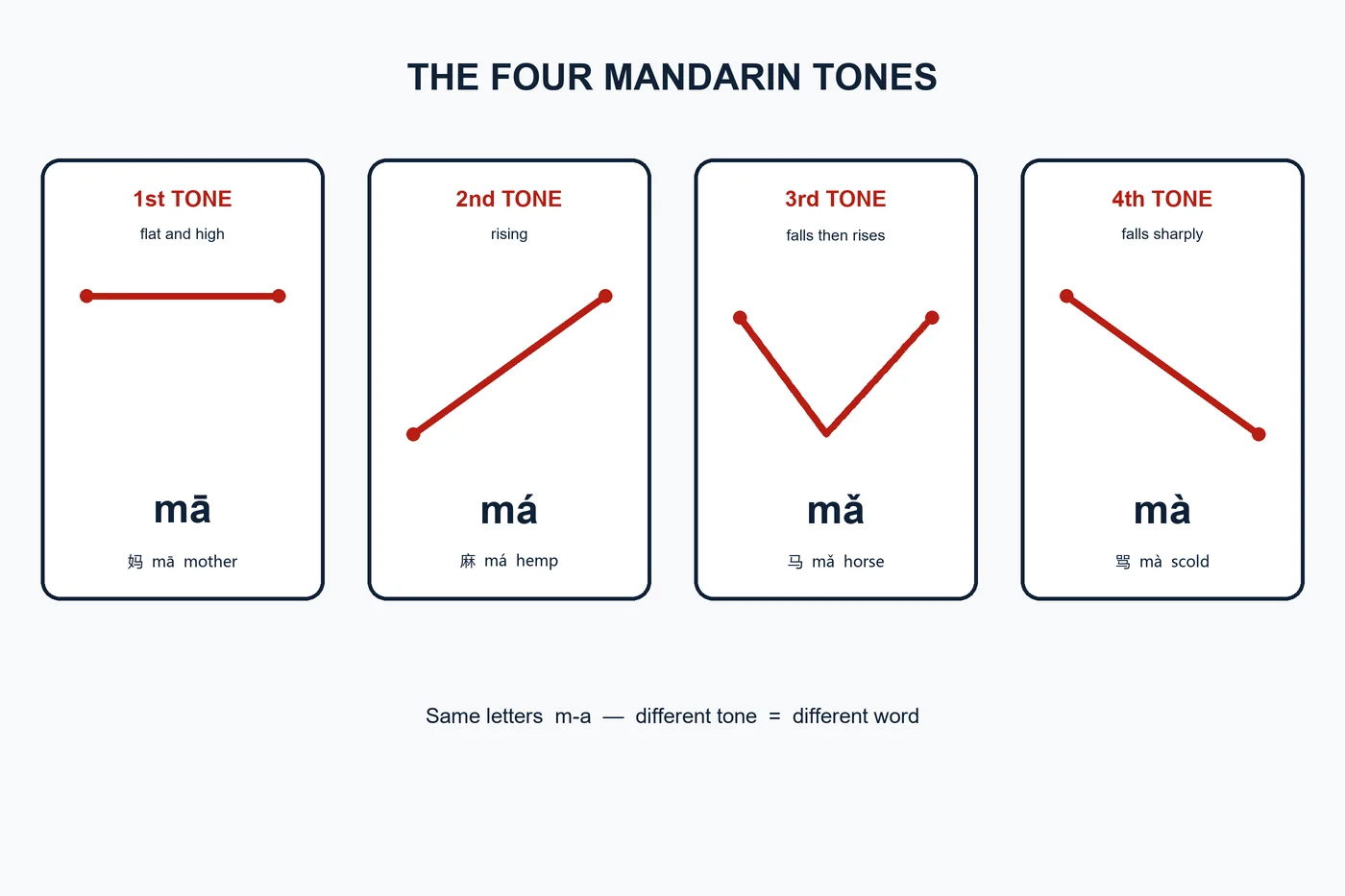
A single syllable can have different meanings. Example:
Many beginners focus only on letters. However: Wrong tone can change the meaning. Practice:
Practice: mā
má
mǎ
mà
Before learning many words.

Listen and repeat immediately. Good materials:
Compare: Your pronunciation
vs
Native pronunciation
This helps identify problems quickly.
Beginners can use:
Useful for:
Good for:
A teacher can help correct:
Learn: ✅ Four tones
✅ Basic initials
✅ Simple finals
Practice: ✅ Initial + final combinations
✅ Common syllables
✅ Listening exercises
Learn: ✅ Common words
✅ Short sentences
✅ Tone changes
Practice: ✅ Conversations
✅ Reading simple texts
✅ Speaking with native speakers
Yes. For most beginners, Pinyin makes pronunciation much easier. However, it should be combined with character learning.
Most beginners can read basic Pinyin within 1–2 weeks, and pronunciation usually takes several months to settle. Those are rules of thumb reported by teachers, not official standards — your pace depends on contact hours, how closely your first language matches Mandarin sounds, and how much you speak outside class.
The biggest challenges are:
With consistent practice, most learners can improve significantly.
Pinyin is the foundation of learning Mandarin. A strong pronunciation foundation will make everything easier:
Do not rush through pronunciation. Spend time mastering:
A correct beginning will help you progress faster throughout your Chinese learning journey.
Free resource
50 Essential Chinese Phrases
Speak from day one with the 50 phrases that actually come up. Pinyin, English and Chinese for the phrases you will use most in shops, taxis, classrooms and cafés.
Related guides
Next step
Once the sounds feel natural, put them to work with ready-made everyday sentences.
Learn 50 essential phrasesOfficial resources: Ministry of Education / State Language Commission — the Hanyu Pinyin scheme (approved 11 February 1958) and the national language standards built on it.
Disclaimer: This is a practical learning guide, not an official standard. Language norms and syllabi are revised periodically. Always confirm with the relevant authority, institution or official source before you rely on it.
