The China Helper
Your practical guide to studying, living and learning in China.
The China Helper
Your practical guide to studying, living and learning in China.

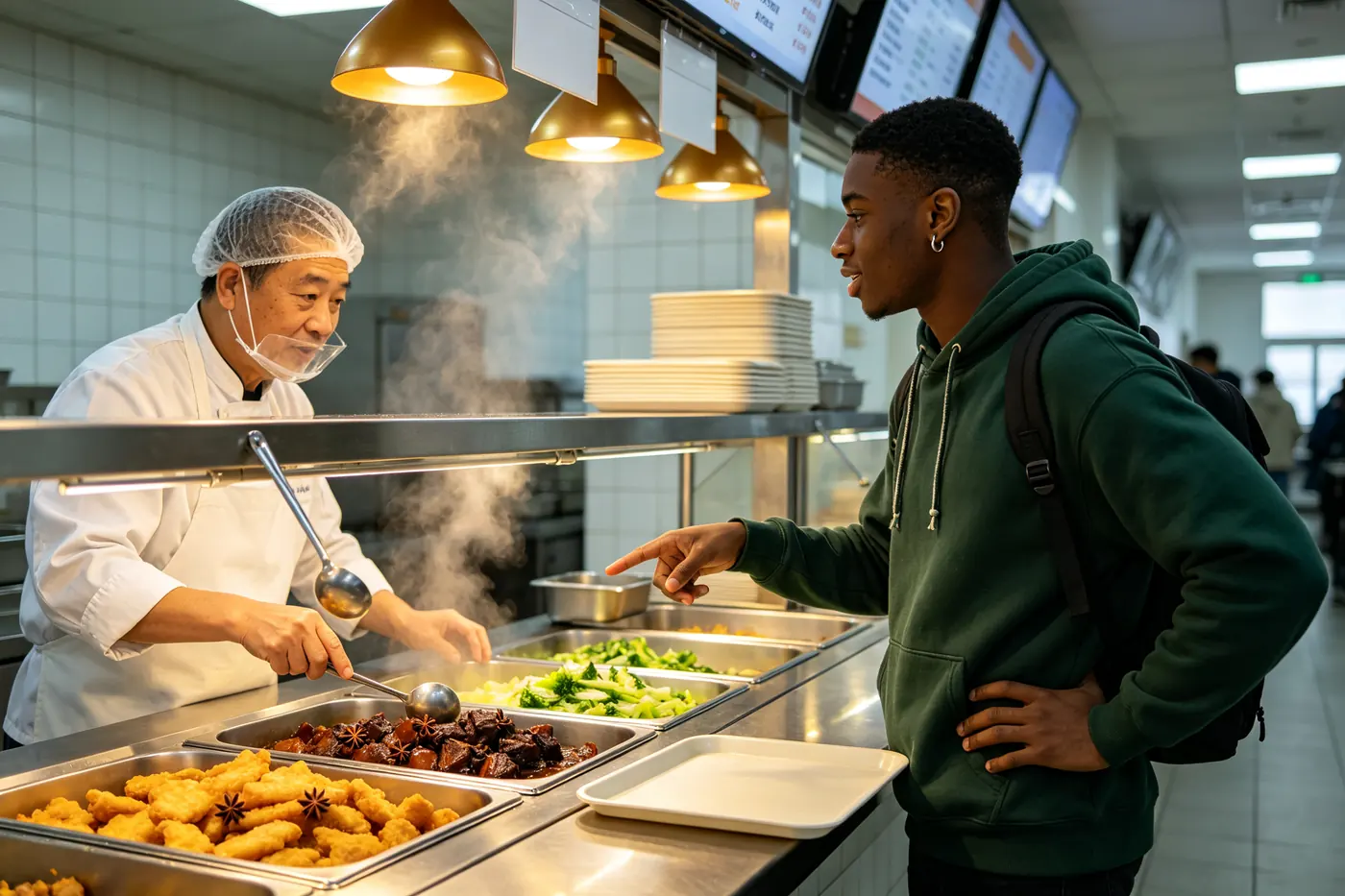
Ordering food is the first conversation most students have in Chinese, and it is the one that repays practice fastest — you get to eat afterwards, and you will repeat it three times a day. What makes it feel hard at the start is the assumption that you need to follow everything being said to you. You do not. Food ordering is highly scripted: there are around a dozen lines that cover the great majority of exchanges, and the rest is pointing. This guide gives you those lines, explains how canteen counters and small restaurants each actually run, covers the dietary restrictions that trip people up — including the fact that ‘vegetarian’ in China frequently includes egg, dairy and sometimes fish broth — and finishes with what to do when your pronunciation does not land. Nobody expects fluency at a food counter. They expect you to be trying.
Check the official source before you act
Romanisations here follow standard pinyin so you can pronounce them rather than guess. Menus, QR ordering systems and dietary practice vary enormously between regions and individual restaurants, and nothing below should be relied on if you have a severe food allergy: get an allergy card written in Chinese before you travel, and confirm ingredients with the person cooking. This guide is language practice, not medical or dietary advice.
Last reviewed: September 2026 · Part of our Learn Chinese guide series.
At a glance
Quick answer
Point at what you want and say 这个 (zhège, ‘this one’), then modify it: 不要 X to remove something, 要 X to add it, 多少钱 to ask the price. That plus please-thank-you covers most counters. In a small restaurant, scan the QR code on the table or ask what is good; at a canteen, take a tray, point along the line, and pay at the card reader. Say 不要辣 if you cannot handle chilli, 打包 for leftovers, and 买单 to ask for the bill. If nobody understands your pronunciation, show the characters typed on your phone and let them read it — this happens constantly and nobody minds. Tipping is not customary in mainland China.
Beginners often prepare for ordering as if it were a listening exam, and then freeze when the person behind the counter replies at full speed with a follow-up question they did not anticipate. In practice the follow-up is nearly always one of a handful of things: eat here or take away, spicy or not, which size, or payment method. If you can recognise the shape of the question, you can answer it — and if you cannot, smiling and repeating your order works fine.
So prepare output rather than comprehension. Twelve lines that you can say clearly beat a hundred you half-recognise. Everything else — the words for individual dishes — you can point at, read off a menu, or look up while you wait.
Learn these in order. They are arranged roughly in the order an exchange happens, so practising down the column is very close to practising the conversation itself.
| Chinese | Pinyin | What it does |
|---|---|---|
| 你好 | nǐ hǎo | Hello — opens every interaction; use it before asking for anything |
| 请给我…… | qǐng gěi wǒ | Please give me… — softer and more polite than just stating what you want |
| 这个 | zhège | This one — said while pointing; the single most useful word at a canteen counter |
| 那个 | nàge | That one — for the dish further away from your hand |
| 要 | yào | I want — attach it to anything on the menu |
| 不要 | bú yào | I don’t want — how you remove an ingredient |
| 有没有……? | yǒu méiyǒu | Do you have…? — useful for vegetarian options and things not on the menu |
| 多少钱? | duōshǎo qián | How much is it? — ask before you commit in places with no prices displayed |
| 不要辣 | bú yào là | Not spicy — the line foreigners most often need and forget |
| 少放辣 | shǎo fàng là | Go light on the chilli — better than nothing if you enjoy a little heat |
| 打包 | dǎbāo | Bag it up — for leftovers or takeaway |
| 买单 / 结账 | mǎidān / jiézhàng | The bill, please — either is fine at a counter or a table |
Two small additions pay off immediately: 谢谢 (xièxie, thank you) and 好吃 (hǎochī, delicious). Complimenting the food costs you nothing and buys real goodwill with the people who will be cooking for you all year.
A university canteen is designed for volume and speed, which means nobody is going to engage you in conversation. The routine is fixed: take a tray and move along the counter, point at the dishes you want as you pass them, then reach the till and pay — usually with your campus card, sometimes with a QR code. Speaking is optional at almost every step.
To get someone’s attention, use the form of address rather than a hello. Staff at a counter respond to 阿姨 āyí (roughly ‘auntie’, used for women of the age your parents would be) or 师傅 shīfu (a respectful term used widely for skilled workers, including cooks). Both are friendly; omitting them and shouting hello is not.
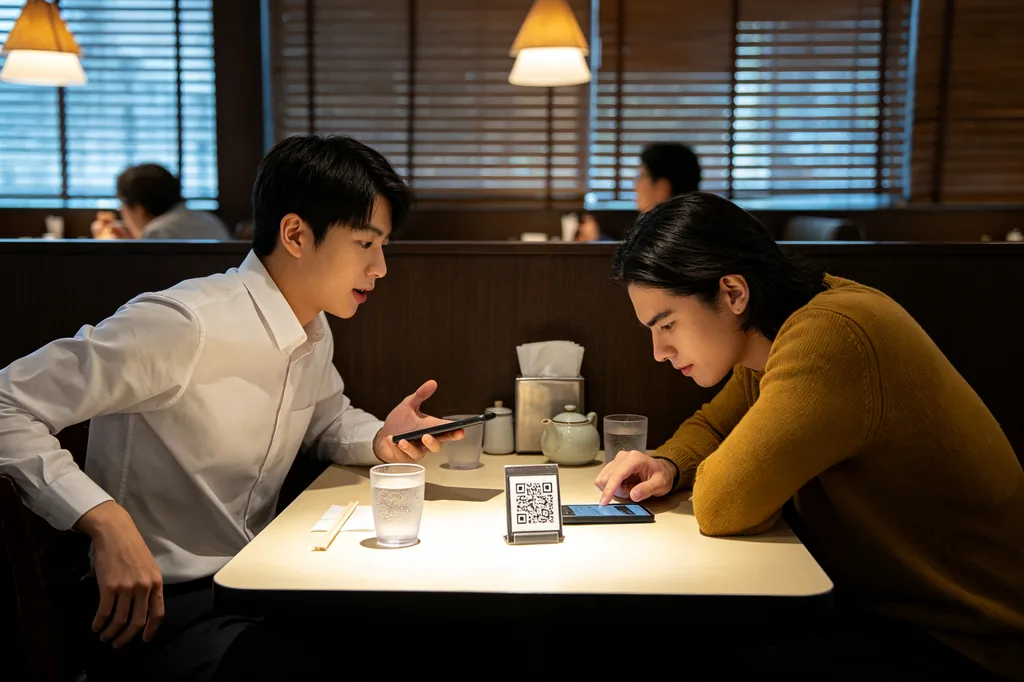
Sit-down restaurants handle things differently and frequently have no printed menu at all. You scan a QR code on the table and order through a mini-program inside a super-app, which means the whole interface is in Chinese and sometimes the only way to order. Three things make this manageable.
When there is no QR code, someone will come and stand hopefully nearby. If there is a dish you have enjoyed elsewhere, describe it and ask 有没有… — ‘do you have it?’ — rather than requesting it directly. Restaurants often have something close even when the exact dish is not on their list.
Quantities matter more than you might expect, because portions are generous and a single dish often feeds two. Getting the number wrong is how students end up with three lunches in front of them.
This is the part worth preparing carefully in advance, because the vocabulary is genuinely different from what English speakers expect. Vegetarian eating in China often includes egg, dairy and occasionally seafood-based stock, so simply asking for 素菜 sùcài may not do what you think it does. Halal restaurants are common near universities and are easy to identify once someone has pointed one out to you — ask your international office on day one where the nearest one is.
Severe allergies: put it in writing
Never rely on spoken Chinese for a serious allergy. Have the allergy written in characters on your phone and show it before ordering, or ask your university to prepare a card for you. Keep any prescribed adrenaline with you, know the word for it in the local context, and read our food guide for how ingredients are usually described on menus.
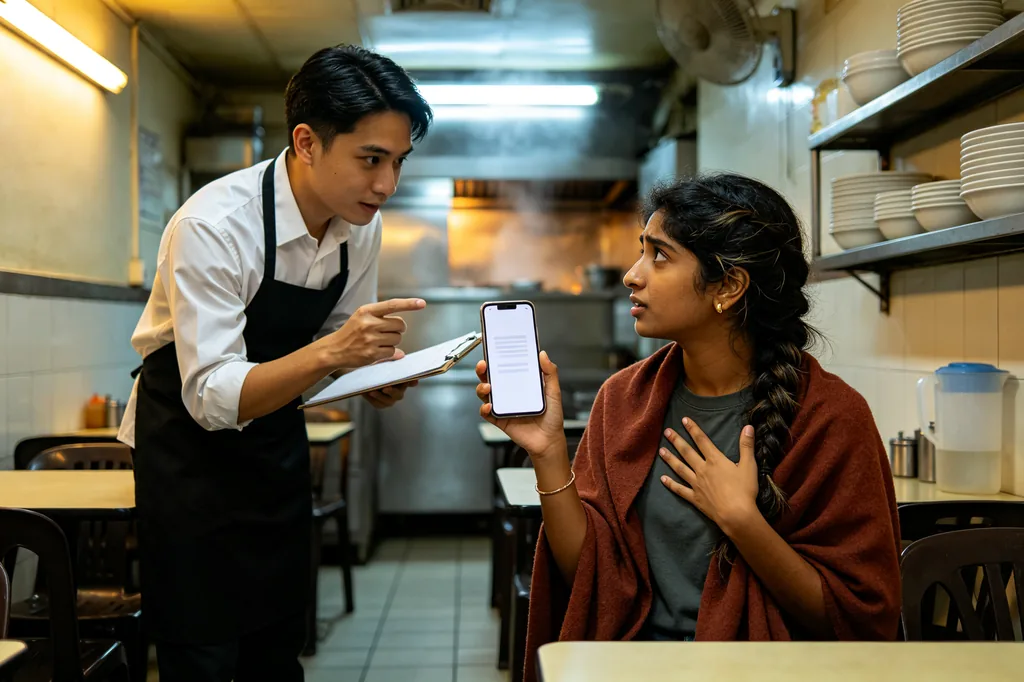
It happens to everyone, and it usually means a tone was off rather than the word. Try these in order rather than repeating the same sentence louder, which never helps.
Payment is either at the counter when you order, or at the end when you ask for the bill with 买单. Many restaurants let you pay from the table by scanning a code on the bill folder. Tipping is not customary on the mainland, and leaving change behind tends to cause mild confusion rather than pleasure.
For leftovers, ask for 打包 and they will bag them; providing a container is not expected of you. If you need a receipt — for a work expense claim, for instance — ask for it before you pay, since it is much harder to produce afterwards. Then take your tray back to the return point and leave; there is no lingering-and-waiting-for-the-check ritual here.
Free resource
Free China downloads
Checklists, phrase sheets and character packs you can print and keep — built for students in their first weeks in China.
Related guides
Next step
Ordering is one conversation. Once the food arrives you will want the rest of the toolkit — greetings, directions, shopping and admin in fifty lines you can carry in your head.
Get the 50 essential phrasesDisclaimer: Rules, prices and platform features in China change frequently and can vary by city, institution and individual circumstances. Always confirm with the relevant authority or provider before making arrangements.
