The China Helper
Your practical guide to studying, living and learning in China.
The China Helper
Your practical guide to studying, living and learning in China.


The panic usually arrives about a week before departure, when someone tells you that Chinese food is pork all the way down. It is not. A country with this much Buddhist history, this much vegetable-forward regional cooking and a Muslim population measured in tens of millions has been feeding people without pork for a very long time. The difficulty is not availability. It is vocabulary. Nobody is going to stop you eating; the problem is that the word you know and the word on the menu are not the same word, and a dish described as vegetable something can arrive sitting in a broth that simmered with meat for six hours. This guide is about closing that gap: what actually counts as vegetarian here, where hidden animal products turn up, how halal eating works in practice outside the big Muslim quarters, and the handful of sentences that get you a meal you can eat.
Check the official source before you act
Restaurant practice, ingredient habits and labelling rules vary by city, by establishment and by cook, and nothing here is verified by inspection. If you have a severe allergy or a strict religious requirement, ask directly at the counter and judge the answer; where there is doubt, walk away. This guide is general information, not dietary, medical or religious advice.
Last reviewed: September 2026 · Part of our Life in China guide series.
At a glance
Quick answer
Tell the server what you cannot eat before you order anything, using the plainest possible sentence, and ask specifically whether the dish contains meat stock. In practice that means four things: say you do not eat meat (or pork), avoid dishes described only as ‘in sauce’ or ‘in broth’, favour tofu, aubergine, greens and mushroom dishes that are cooked to order, and remember that Chinese Buddhist temple dining halls and Lanzhou noodle shops are reliable fallbacks in almost every city. Carry a written card if you have a serious allergy, and do not rely on spoken Chinese alone for something that could put you in hospital.
The common fear is scarcity. In reality most regional cuisines here have a deep vegetarian repertoire that predates modern Western vegetarianism by centuries — Buddhist monastery cooking built an entire tradition out of tofu, gluten, mushrooms and seasonal vegetables, and its techniques leaked into ordinary restaurants long ago. Sichuan kitchens braise aubergine in garlic and chilli. Hunan cooks toss long green beans with pickled mustard greens. Yunnan sends out mushrooms in every season. A canteen tray of rice, greens, tofu and a braised vegetable costs very little and requires no negotiation at all.
So treat this as a vocabulary problem with a cultural overlay, not a supply problem. Once you can say what you do not eat, and once you know which three or four words unlock a safe order, ninety per cent of the difficulty evaporates.
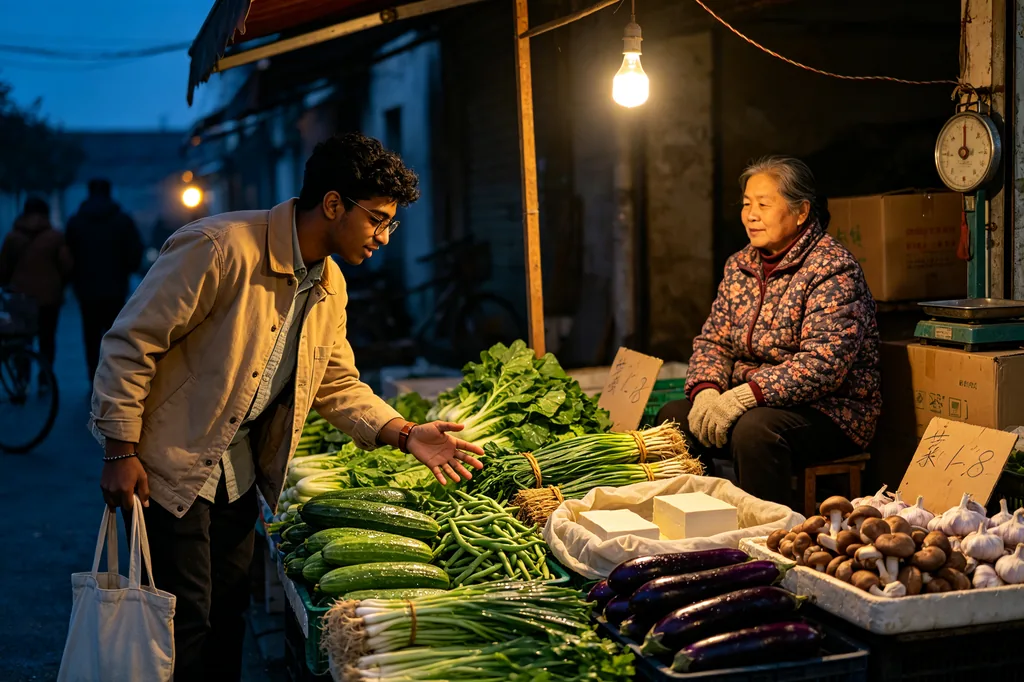
The local term roughly translates as ‘plain’ or ‘simple eating’, and it carries Buddhist connotations: traditionally it excludes meat, fish and pungent vegetables such as garlic and onion, though most modern restaurants use it more loosely to mean no meat. That looseness is exactly why you should never rely on the label alone.
Two practical consequences follow. First, a dish can be labelled vegetarian and still use animal fat or stock, because the cook is thinking ‘no chunks of meat’ rather than ‘no animal product’. Second, the word sometimes signals an entire style of restaurant — a vegetarian restaurant, often near a temple, serving mock meats made of wheat gluten and tofu skin that are genuinely excellent and genuinely vegan.
If you are avoiding meat for health, religion or ethics, these are the usual stowaways. None of them announce themselves on the menu.
| Hidden item | Where it appears | What to ask |
|---|---|---|
| Meat or chicken stock | Vegetable soups, braised greens, hotpot broth, noodle bowls, anything described as being ‘simmered’ or ‘in supreme broth’ | Ask whether the broth contains meat — ask about the liquid, not the vegetables |
| Lard | Pastry, flaky flatbreads, some fried greens, certain fried rice | Worth asking at bakeries; hard to detect by eye once cooked |
| Dried seafood and its powder | Braised tofu, hot and sour soup, stir-fried greens for savoury depth | Usually undetectable by taste unless you know what to look for |
| Oyster sauce | Anything stir-fried ‘in sauce’, particularly greens and noodle dishes | Ask for the dish without oyster sauce; most kitchens will oblige |
| Chicken powder or stock granules | Almost all wok cooking in cheaper restaurants, as a seasoning | Impossible to avoid outside vegetarian restaurants; decide your own tolerance |
| Pork floss or mince as garnish | Congee, cold noodles, steamed buns, rice rolls | Visible — check before you eat rather than asking afterwards |
| Cooking oil shared with meat | Frying and deep-frying stations generally | Rarely raised as a concern; matters only to the strictest eaters |
Severe allergies need writing, not speaking
A spoken explanation of a serious allergy can be lost in pronunciation, background noise or an unfamiliar accent. Have the allergy written down in characters on your phone, show it before you order anything, and keep any prescribed adrenaline with you. This is the one case where politeness should never outrank clarity.
Halal food here is not a niche offering bolted onto restaurant week. There is a long-established Hui Muslim restaurant tradition across the country and a distinct Uyghur tradition from the northwest, and between them most cities of any size have reliable halal eating within walking distance of the centre.
Around a university, halal provision is usually explicit: many campuses run at least one halal canteen window or a dedicated dining hall, because Muslim students are a regular and expected part of the student body. Ask your international office on day one rather than working it out from scratch.
You need five, maybe six. Delivered badly they still work, because the topic is concrete and the staff already know what you are likely to mean. Say the exclusion first and the request second.
| Say it like this | Roughly | When to use it |
|---|---|---|
| wǒ chī sù | I eat vegetarian | Opening move at the counter; pair it with what you do not eat |
| wǒ bù chī ròu | I don’t eat meat | Clearer than any abstract label; say it before ordering |
| wǒ bù chī zhūròu | I don’t eat pork | The single most useful sentence for halal eaters anywhere in China |
| zhèige yǒu ròu ma | Does this contain meat | Point at the menu line; works even if your tones are rough |
| yǒu méiyǒu ròu tāng | Is there meat stock in it | The one that catches invisible animal products |
| bù yào jījīng, xièxie | No chicken powder, thanks | For strict vegetarians; kitchen staff understand it immediately |
If this looks like a lot to carry, note that you can survive on the third and fourth lines alone. Pointing at the menu while saying the question is completely standard behaviour and gets a straight answer.
Self-catering removes the negotiation entirely. Supermarkets stock tofu in every texture, wheat gluten, dried and fresh mushrooms, yuba, a genuinely astonishing range of leafy greens, and cheap seasonal fruit. Wet markets are cheaper still and better for vegetables, though they involve more pointing and less English. Kitchens in student accommodation are often basic, but even a shared electric wok gets you stir-fried greens with garlic in four minutes.
Packaged food labels are governed by local rules and vary in usefulness. Treat the ingredient list rather than any claim as authoritative, and use your phone camera with a translation app when it matters. This is one place where the camera is genuinely better than your Mandarin.
This is where dietary restrictions get socially awkward rather than logistically awkward. Hospitality here is expressed through food, quantity and ordering on behalf of the table, so a restriction can read as a criticism of the host’s generosity. It is not, but it can feel like it.
It will, occasionally, and usually through optimism rather than carelessness: the cook remembered there was no meat and forgot the stock, or the person who took your order was not the person cooking. Nothing is served in an atmosphere of solemn dietary vigilance, and treating a mistake as a moral failure will cost you more than the meal did.
Send it back quietly if it genuinely cannot be eaten; nobody is insulted. Order something simple — plain greens, rice, tofu — which comes quickly and reassures the table that you are being fed. Then remember which restaurant it was, because the answer is rarely to abandon a place over one dish.
Free resource
Free China downloads
Checklists, phrase sheets and character packs you can print and keep — built for students in their first weeks in China.
Related guides
Next step
Restrictions are one end of the problem. Understand what everyone else is eating and why, and most menu confusion disappears with it.
Read the food and dining guideDisclaimer: Rules, prices and platform features in China change frequently and can vary by city, institution and individual circumstances. Always confirm with the relevant authority or provider before making arrangements.
