The China Helper
Your practical guide to studying, living and learning in China.
The China Helper
Your practical guide to studying, living and learning in China.

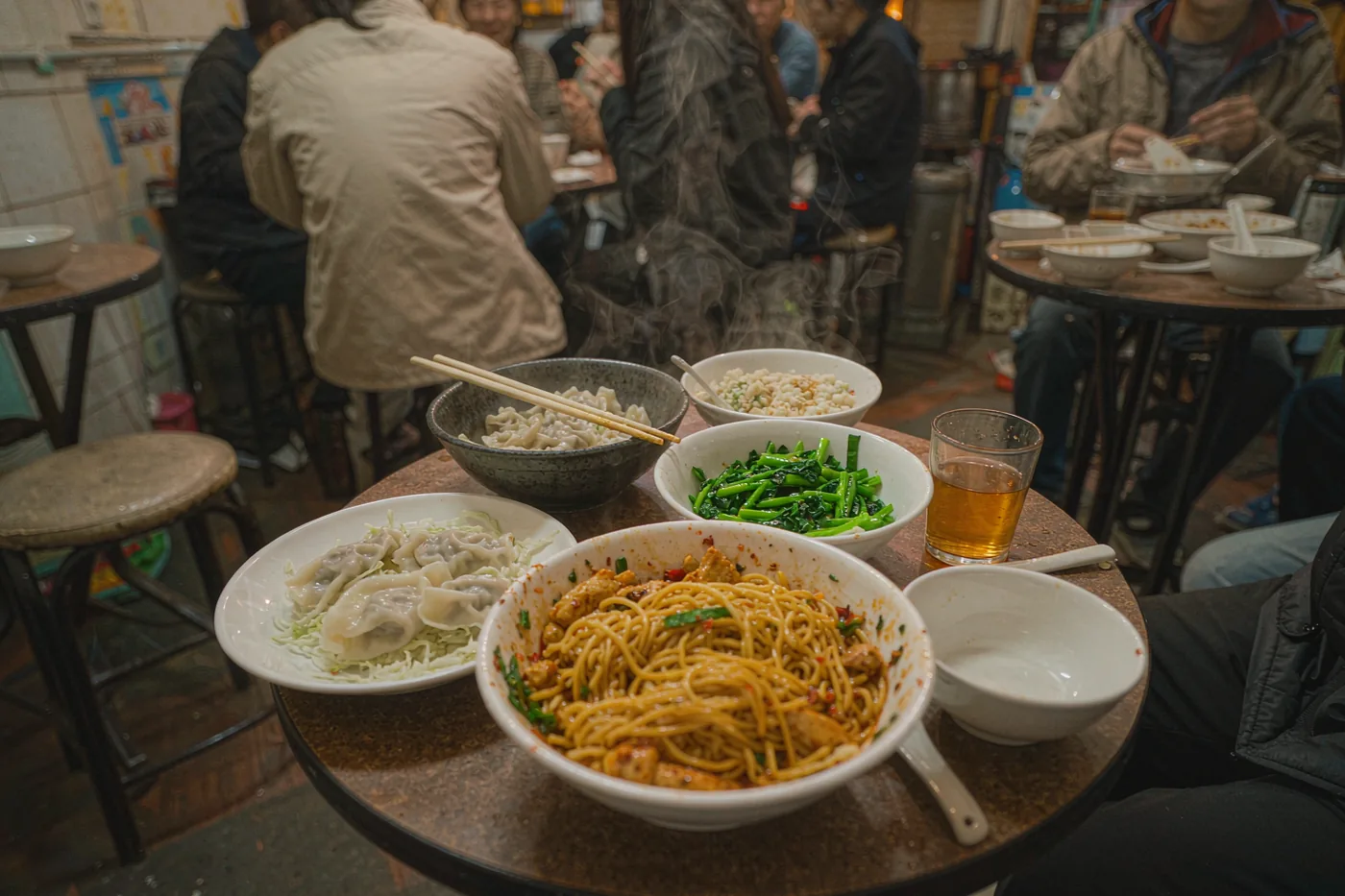
How to order, pay, handle dietary needs and eat well on a student budget in China — from canteen trays to hot pot and delivery apps.
Food in China is one of the best parts of student life — and one of the most affordable. This guide covers canteens, restaurants, delivery apps, street food and how to handle allergies as an international student.
Check the official source before you act
This guide reflects rules and prices as published by Chinese authorities and providers, and was last reviewed in September 2026. Rules, fees, platform features and deadlines change, and city offices and branches apply them differently. Confirm the current position with your university canteen, the restaurant, or the market regulator for food-safety concerns before you rely on any figure below.
Last reviewed: September 2026 · Part of our Life in China guide series.
At a glance
Quick answer
A university canteen meal costs ¥8–20, a casual restaurant meal ¥25–60, and delivery ¥20–40. Almost all ordering and payment runs through WeChat or Alipay — set one up in your first week, and get your address written in Chinese before you try food delivery.
Food is one of the parts of China that most students end up loving — and one of the parts that causes the most anxiety in the first few weeks. Menus are often picture-heavy but character-only, the ordering system runs on apps you have not set up yet, and nobody at the table is speaking English. The good news is that eating here is cheap, varied and extremely well-organised once you know the routine. This guide walks through how to feed yourself from day one, what it costs, and how to handle the situations where you cannot read a thing.
About these figures: they are typical ranges reported by international students in 2025–2026, not official statistics or regulated prices. City, campus and lifestyle move them a lot — use them to set an initial budget, then check current prices once you arrive.
Your food budget is the second-largest line item after rent, and it is also the one with the widest range. Eating every meal at the university canteen and cooking occasionally puts you around ¥900 a month. Eating out twice a day in a tier-1 city pushes you past ¥2,500. Most students land somewhere in between.
| Where you eat | Typical cost per meal | Notes |
|---|---|---|
| University canteen | ¥8 – 20 | Cheapest option by far. Subsidised at most public universities. |
| Street food / stall | ¥5 – 20 | Breakfast items (jianbing, baozi) are the best value in the country. |
| Casual local restaurant | ¥25 – 60 | Per person, sharing three or four dishes between two or three people. |
| Food delivery | ¥20 – 40 | Plus ¥2–6 delivery fee; heavy discount coupons for new users. |
| Hot pot / BBQ (group) | ¥60 – 120 | The standard social meal. Cheaper per person with more people. |
| Western / international | ¥70 – 150 | Priced as a treat, not a habit. Quality varies wildly. |
| Cooking yourself | ¥15 – 30 per day | Depends on whether you want imported ingredients or local ones. |
Those numbers assume a mid-tier city. Beijing, Shanghai and Shenzhen run maybe 30–50% higher for restaurants and delivery, while canteen prices stay similar because they are subsidised. For a fuller monthly breakdown across cities, see the cost of living guide.
The canteen (食堂, shítáng) will do most of the heavy lifting in your first year. Most universities have two or three, they open from around 6:30am to 8pm, and they serve a mix of rice-and-dish trays, noodle stations, dumpling counters and a handful of regional specialities.
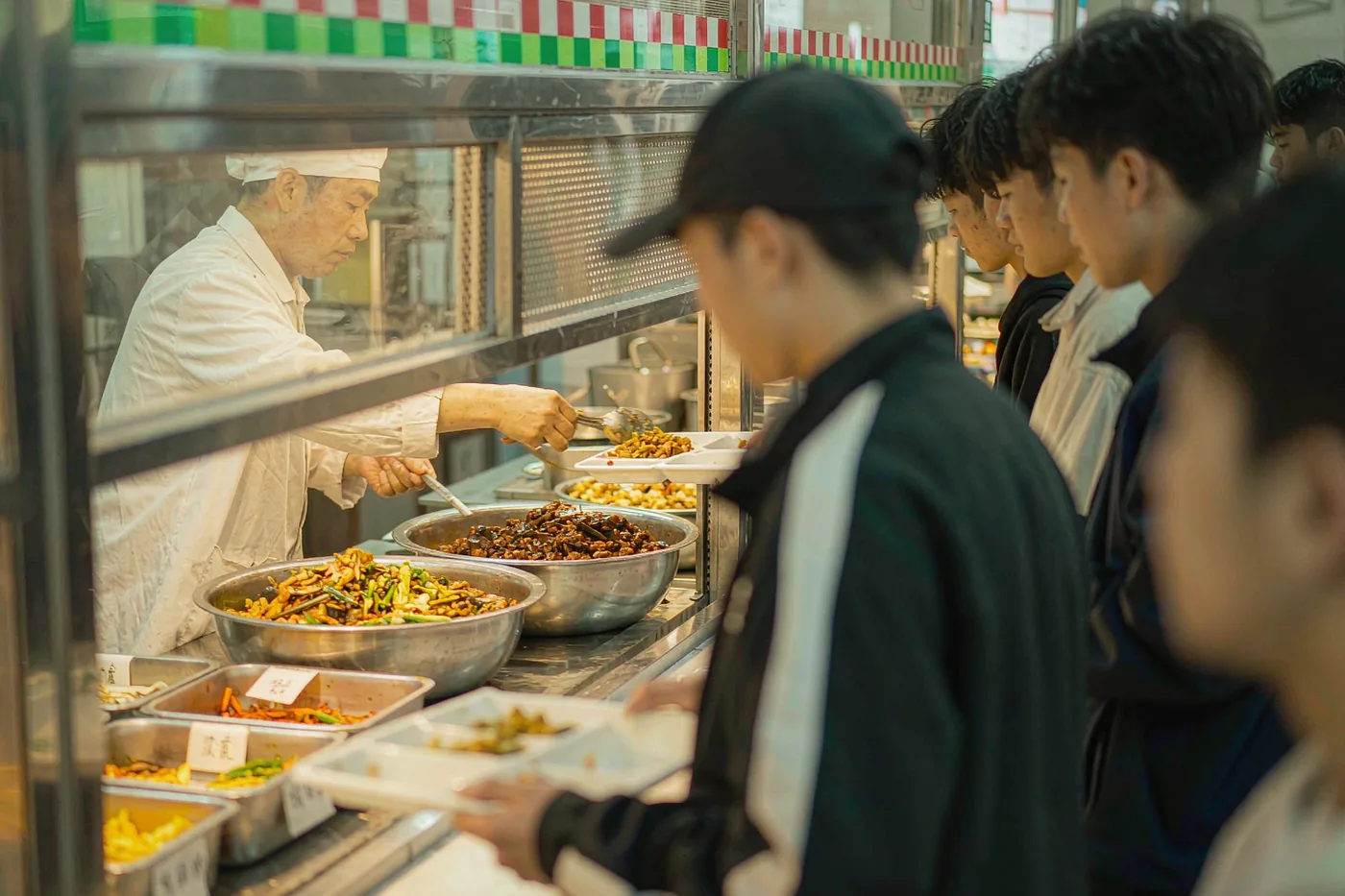
The routine is straightforward: pick up a tray, walk the counter line, point at what you want, and tap your campus card or phone. Rice dishes are usually priced per portion with meat dishes costing more than vegetable ones. Noodle and dumpling stalls cook to order — you pay at one window and collect at another, often with a numbered slip.
Two things catch newcomers out. First, canteens can close early and with little warning, particularly during holidays — an empty canteen at 7pm is common outside term time. Second, some universities operate a separate canteen for international students with slightly higher prices and a more limited menu; the local canteens are cheaper and usually better. Ask a Chinese classmate which one they actually eat at.
This is where most of the stress lives, and it is more solvable than it looks. Chinese restaurants have adapted to guests who cannot read, so several workarounds exist before you need any vocabulary at all.
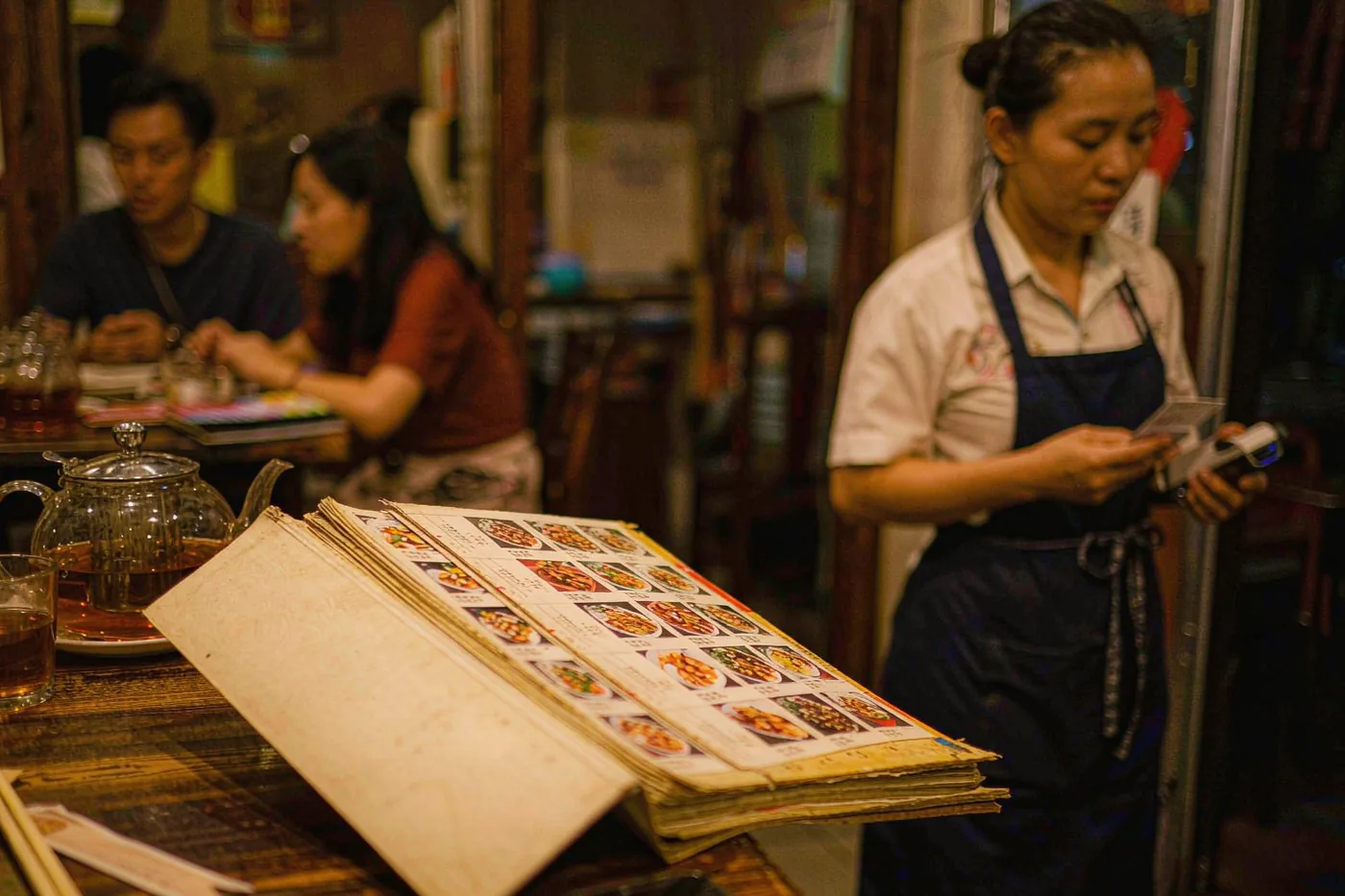
Ordering logic differs from the West in one important way: dishes are shared. Two people order two or three dishes plus rice, not one dish each. If you order one dish per person you will end up with far too much food, which is socially fine but wasteful and more expensive.
On spice: 微辣 (wēi là) means mild, 中辣 medium, 特辣 very hot. In Sichuan, Hunan and Chongqing, “mild” is still quite hot by international standards. If you genuinely cannot take chilli, say 不要辣 (bú yào là) and confirm it — some kitchens assume foreigners want it toned down and adjust without being asked.
Worth pairing this with the essential student phrases — the vocabulary overlaps heavily with what you need at a restaurant.
Two apps dominate: Meituan (美团) and Ele.me (饿了么). Both are inside WeChat and Alipay as mini-programs, which means you can use them without downloading anything if the standalone app is awkward on your phone.
You will need WeChat Pay or Alipay working first — delivery apps are useless without one. Once you are set up, the flow is: enter your address, browse, add to cart, pay. Riders typically arrive in 25–40 minutes.
The address is the hard part. Delivery apps want a Chinese address, and an English one will send riders to the wrong building. Get your dorm or apartment address written in Chinese from your landlord, accommodation office or a Chinese friend, save it in your phone’s notes, and paste it rather than retyping every time. Add a landmark in the notes field — “gate 3 of the north campus, red building” — because riders use those more than street numbers.
Other practical notes: new users get heavy discounts for the first week or two, so expect your first orders to be unusually cheap. Riders will call you, usually to say they have arrived at the gate, and many campuses require collection at a gate or a designated pickup point rather than doorstep delivery. Check whether your university has a rule about this before you order.
Street food is cheap, excellent, and the fastest way to feel at home in a city. Breakfast is the standout: jianbing (a savoury crêpe with egg and crisp cracker), baozi (steamed buns), youtiao (fried dough sticks) and soy milk together cost under ¥10 and are available from carts from about 6am.
Night markets (夜市, yèshì) are the evening equivalent — skewers, fried noodles, stinky tofu, grilled seafood, and a lot of regional variety. They typically open around 6pm and run to 10pm or later.
Is it safe? Broadly yes, with the usual caveats. Pick stalls with a queue of locals and high turnover, watch whether food is cooked to order in front of you, and be cautious with raw or cold items in hot weather. Tap water is not for drinking anywhere in China — stick to bottled or boiled water, which canteens and restaurants provide free of charge.
This is the section to read carefully if you have a genuine restriction, because Chinese food culture does not use the same categories that Western labelling does.
| Your need | What to say | What to expect |
|---|---|---|
| Vegetarian | 我吃素 (wǒ chī sù) | Buddhist-style 素食 restaurants exist in most cities. Elsewhere expect egg, dairy and garlic; “no meat” is not the same as vegetarian. |
| Vegan | 纯素 (chún sù) | Harder. Broths often contain meat stock; ask specifically. |
| Halal | 清真 (qīngzhēn) | Well-established — lanzhou lamian (beef noodle) shops are everywhere and reliably halal. |
| Gluten-free | 无麸质 (wú fūzhì) | Genuinely difficult — soy sauce, wheat gluten and flour are everywhere. Self-catering is realistic. |
| Nut allergy | 我对坚果过敏 (wǒ duì jiānguǒ guòmǐn) | Peanuts and sesame are common; carry a written card in Chinese. |
For anything medically serious, get a Chinese allergy card printed before you arrive and show it rather than explaining it. Apps do not reliably translate medical nuance, and kitchens will understand a printed card far better than a spoken sentence.
“Chinese food” as served abroad barely touches what is here. Where you study will shape what you eat, and travelling within China is the fastest way to realise how much variety exists.
Paying. Almost always by scanning a QR code — either the restaurant’s code on the table or showing your own payment code to be scanned. Cash works but is increasingly awkward; some small stalls have no change. Set up Alipay and WeChat Pay as early as you can, ideally in your first week alongside opening a bank account.
Tipping. Not expected and not customary. Leave nothing at local restaurants, canteens, taxis or delivery. A handful of international hotels and Western-facing expat restaurants may add a service charge, and that is on the bill rather than optional.
Table manners that matter. A few are worth knowing: do not stick chopsticks upright in a bowl of rice (it echoes funerary incense); letting the host or the oldest person at the table start first is polite; if someone pours your tea, tapping two fingers on the table is the standard thank-you. And when someone pays for you, the custom is to insist on paying next time rather than splitting.
The hot pot rule worth knowing: raw meat goes into the shared pot, and you fish out what is yours with your own chopsticks. Using your personal chopsticks to move raw meat around is the one real faux pas — most places provide a separate pair for raw food.
Eating well in China has a short learning curve and a long payoff. Your first week will involve a lot of pointing and a few mistakes — that is normal, and nobody is judging you for it. Get your payment apps working, find your cheapest canteen, save your address in Chinese, and learn to read 不要辣. Those four things remove most of the friction, and after that you have access to one of the broadest and cheapest food cultures in the world.
Free downloads
Free China downloads for international students
Free downloads for life in China: budget templates, city guides and student checklists.
Related guides
Next step
Delivery and restaurant ordering both depend on getting WeChat Pay and Alipay working — here is how to set them up as a foreigner.
Set up WeChat Pay and AlipayOfficial resources: Chinese cuisine (Wikipedia) — regional styles and dining customs explained.
Disclaimer: Rules, prices and platform features in China change frequently and can vary by city, institution and individual circumstances. Always confirm with the relevant authority or provider before making arrangements.
