The China Helper
Your practical guide to studying, living and learning in China.
The China Helper
Your practical guide to studying, living and learning in China.


The single best argument for travelling while you study here is that the thing which usually ruins travel budgets elsewhere — the distance — is cheap here, while the things you actually want out of a trip are not. A high-speed train across hundreds of kilometres costs a fraction of its European equivalent, a decent hostel bed is priced like a few coffees, and a bowl of noodles eaten standing up costs less than the same lunch in a university cafeteria back home. What you do need is knowledge, because the cheap options are not obvious to someone booking from abroad, the booking ecosystem runs almost entirely through Chinese apps, and there are a handful of ways to lose real money through simple ignorance. This guide covers the transport maths, where to sleep, eating for very little, the discounts your student card unlocks, five routes that work well on a tight budget, and the costs people forget to include.
Check the official source before you act
Fares, admission prices and student discount rules change frequently and are set locally, so treat every figure here as an order of magnitude rather than a quote and verify current prices before booking. Always obey the conditions of your visa and registration, keep your passport accessible, and follow local guidance. This is general information, not financial or legal advice.
Last reviewed: September 2026 · Part of our Study in China guide series.
At a glance
Quick answer
Build the trip around trains rather than flights, choose second class rather than first, and take an overnight sleeper when the journey is long enough to replace a night’s accommodation. Stay in hostel dorms or, where available, cheap university guesthouses; eat where locals eat, which means street food and small noodle shops rather than restaurants aimed at visitors; and carry your student card to half-price admission at most attractions. Book tickets through the official railway app or its mini-program inside a Chinese payment app, and always leave one buffer day — and one buffer night’s accommodation money — for the delay that everyone eventually hits.
People arrive with wildly wrong expectations in both directions. Some assume everything is dirt cheap and then feel swindled by a taxi; others assume a trip across the country must be expensive and never book it. The reality is that transport and food are unusually affordable, accommodation spans an enormous range, and anything connected to a famous attraction costs considerably more than the ordinary version of the same thing.
The useful mental model is this: you can travel here in real comfort for roughly the price of staying home, provided you are willing to take trains rather than flights, eat where locals eat, and sleep in dorms or ordinary budget hotels rather than international-brand ones. Every one of those is a quality-of-life choice, not a hardship, and most long-term students find they prefer it.
For journeys of roughly two to six hours, high-speed rail is usually faster door to door than flying once airport transfers and security are counted, and considerably cheaper than last-minute air travel. For longer hauls or unfavourable timing, an overnight sleeper has the additional advantage of being transport and accommodation in one purchase.
| Option | Best for | What to know |
|---|---|---|
| High-speed rail | Two to six hour hops between major cities; the default choice | Book ahead on popular routes; tickets are released a limited number of days before departure and disappear before holidays |
| Overnight sleeper train | Long journeys where you would otherwise pay for a hotel | Soft sleeper costs more and is worth it; bring earplugs and expect an early arrival |
| Regular express train | Very short budgets and routes without high-speed service | Much slower but genuinely cheap; hard seat is an experience rather than a recommendation |
| Long-distance coach | Reaching towns and scenic areas without rail links | Useful for the last leg; schedules are less predictable and comfort varies |
| Budget flights | Crossing the country when booked far ahead | Compare carefully — the airfare saving is often eaten by airport transfers at both ends |
| Shared ride-hailing and buses within cities | Station transfers and daily movement | Public transport is extensive and very cheap in most cities; learn it before falling back on taxis |
Book tickets where the locals book them
Tickets sell through the official railway app and through mini-programs inside the mainstream payment apps, and popular trains do sell out. International booking sites generally add a service margin and give you fewer options. Whichever route you use, set up and test your ticket collection method days before departure rather than at the station.
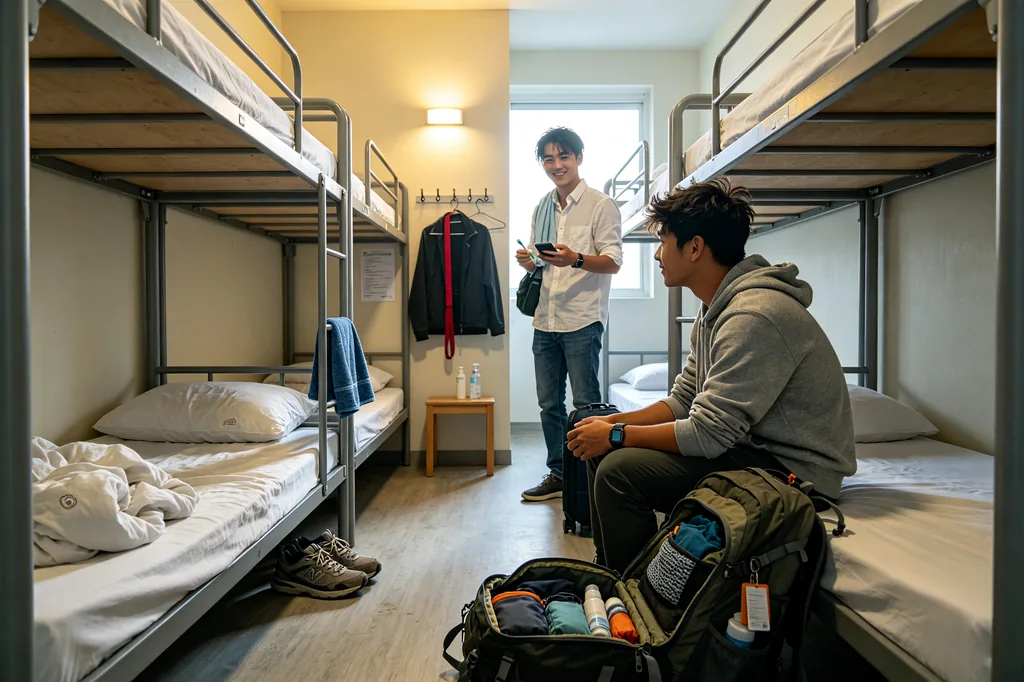
Hostels exist in most tourist cities and their dorm beds are the single cheapest decent option. Beyond that there is a wide band of inexpensive local hotels that are perfectly serviceable and rarely appear on international booking sites, which means you often get a better price by walking in than by booking from abroad — though this costs time and only works outside peak periods.
This is where budget travel here is genuinely excellent rather than merely cheap. Street food, small noodle shops, dumpling counters, breakfast stalls and the evening market are all priced low and are all the same food locals queue for. A filling bowl of noodles, baozi and a drink for breakfast, or a plate of dumplings in the evening, costs a small fraction of a restaurant meal aimed at visitors.
Major scenic sites charge admission, and that is often the largest single line in a student travel budget. The good news is that student pricing is widespread; the bad news is that it is inconsistently advertised and sometimes requires the right card.
These are chosen for cheap transport between stops, affordable accommodation, plenty that costs nothing to look at, and a reasonable tolerance for learners of Mandarin. Adjust freely — the point is the structure, not the exact itinerary.
| Route | Why it suits a tight budget | Rough shape |
|---|---|---|
| Xi’an and the Silk Road eastwards | Compact historic core, excellent street food, cheap accommodation, abundant rail connections | Three or four days; add a detour for the Terracotta Army and use the city walls and Muslim Quarter as free-ish evenings |
| Chengdu and nearby Sichuan towns | Cheap eating everywhere, dense bus and rail links, plenty of free walking | Three days city plus one or two day trips; pandas require an early start and a booked ticket |
| Yunnan’s north: Kunming, Dali, Lijiang | Long-standing traveller infrastructure, dorm beds everywhere, scenery needs no admission ticket | A week minimum given distances; budget extra for the intercity legs |
| The Yangtze delta: Hangzhou, Suzhou and water towns | Very short hops between cities, dense rail network, walkable centres | Four to five days; gardens and lakes are the cost, everything else is cheap |
| Chongqing and the gorges approach | Cheap food, striking city, easy onward transport, few tourists relative to the well-known alternatives | Three days; combine with Sichuan or continue east |
Trips go over budget through accumulation more often than through one big mistake. These are the lines that catch people out.
Keep your passport with you rather than in a bag going elsewhere, keep a photograph of it somewhere accessible, and know where your accommodation registration paperwork is. Some border regions and some areas require additional permits arranged in advance through an agency or the relevant authority — check before you travel rather than on arrival, because the answer is sometimes no at short notice.
Beyond that, ordinary precautions suffice: share your itinerary with someone, keep your university’s emergency number stored, download offline maps, and do not accept unsolicited offers of tours from people who approach you at stations. The scams that exist here are mostly variants of ones that exist everywhere else.

Free resource
Free China downloads
Checklists, phrase sheets and character packs you can print and keep — built for students in their first weeks in China.
Related guides
Next step
Getting there is the mechanical part. Knowing what a ticket really involves — booking windows, seat classes, collecting a paper slip — saves the most money overall.
Read the trains and flights guideDisclaimer: Rules, prices and platform features in China change frequently and can vary by city, institution and individual circumstances. Always confirm with the relevant authority or provider before making arrangements.
